Question 8 of 15 · CIE-2 QB · Set 2 · 6 marks
Open in ChatGPTDistinguish between NFS and AFS based on architecture, caching mechanisms, consistency, and file access.
Introduction
NFS and AFS are the two classic network file systems. Both let a client use a remote directory as if it were local; they differ in how the server is structured, how the client caches, and therefore how consistent a shared file looks.
Architecture
- NFS is a stateless server: each call (
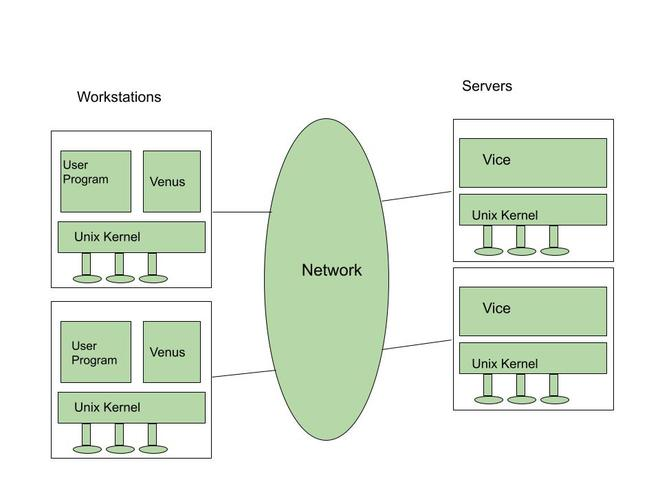
LOOKUP,READ,WRITE) carries the file handle, and the server keeps no per-client state. Mounting is done by the client's mount protocol, and file handles identify files across reboots. - AFS is stateful at session level: the client establishes a callback with the server, the server records which clients hold which files, and the server contacts the client when a file changes.
Caching
- NFS caches file data and attributes on the client, with timestamps. A cached block is revalidated when it is older than a few seconds; attribute caching makes
statcheap. - AFS caches the whole file on the local disk and validates it through callbacks: the server promises to notify the client when the file changes.
Consistency
- NFS gives close-to-open consistency: writes are flushed on
closeand a cached copy is revalidated onopen, so a client sees changes made by another client after it reopens the file. - AFS gives session semantics per file: while a file is open the client holds it, and the callback guarantees the cached copy is invalidated as soon as another client writes.
File access
- NFS performs fine-grained, per-block remote access; the server is contacted for blocks that are not cached.
- AFS transfers whole files and works well over slow wide-area links, which is why it was designed for campus-wide file sharing.
Comparison
| Point | NFS | AFS |
|---|---|---|
| Server state | Stateless | Callback state |
| Cache unit | Blocks | Whole files |
| Consistency | Close-to-open | Callback invalidation |
| Scale | Local network | Wide area, many clients |
| Failure of server | Client retries | Callback breaks, client revalidates |
Conclusion
NFS trades weaker consistency for a stateless server that survives restarts easily; AFS trades server state for strong, cache-friendly consistency across a wide area.